


From Research to Real-World Readiness: The WP4 Skills Simulator Pathway
How can vocational training help autistic learners practise a profession safely, confidently and at their own pace? This was WP4’s central question. We aimed to identify occupations and simulation tools for accessible, integrated and interactive training programmes.
The process began with the WP2 and WP3 research and needs analyses. These challenged the stereotype that autistic people naturally belong in a narrow range of STEM occupations. Autistic learners have different interests, strengths, sensory profiles and support needs. We therefore sought varied employment pathways and adaptable learning environments.
We mapped occupations supported by reliable simulations and considered their labour-market relevance. Systems were compared through a weighted framework covering gradual progression, feedback, modularity, visualisation, sensory calmness, usability, motor-skill development, safety, equipment, teacher expertise, technical support, cost and sustainability. Partner experience also informed the decisions.
The portfolio covered welding, car-body painting, logistics and forklift operation, laboratory work, carpentry, vehicle and machine operation, agricultural machinery, auto mechatronics, and production-line control. These fields offer employment potential and tasks that can be divided into repeatable steps. Selection never assumed that every autistic person has the same strengths: suitability must be assessed individually.
Driving needs particular care. Autistic people can learn to drive, and truck or bus driving may suit some individuals because it can offer independence and routines. Yet constantly changing urban traffic demands rapid interpretation, flexible decisions and tolerance of unpredictability. This can be a major challenge. Simulator performance must therefore be followed by individual assessment and a gradual transition to real traffic.
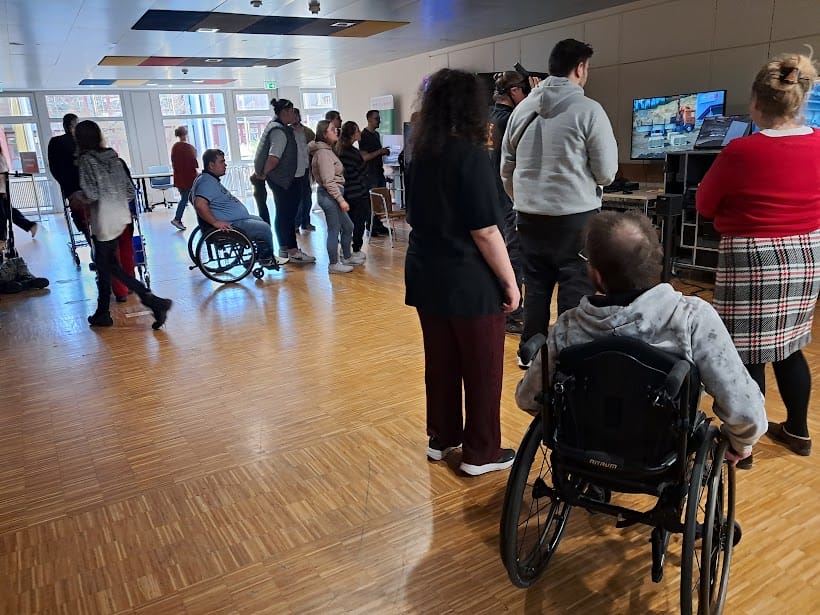
WP4 produced more than a list of simulators: it established a two-stage training concept. Learners begin, whenever possible, on a traditional flat screen, developing concentration, coordination and basic procedures through less intensive practice. They can then progress to XR, gaining spatial presence, realistic tool handling and safe rehearsal of hazardous or expensive tasks. Yet headsets may cause fatigue or sensory overload and are not suitable for everyone.
This is why blended or hybrid training is essential. Flat-screen practice, immersive XR, instructor guidance and real-equipment training complement one another. Learners can repeat modules, adjust the pace, return to an earlier step or use the environment that best matches their preferences.
The final programmes are integrated, interactive preparation pathways—not replacements for workplace practice. Learners can make mistakes without injury, waste or equipment damage, receive consistent feedback and repeat tasks until familiar. This builds confidence, reduces anxiety, improves safety and supports gradual skill acquisition. When learners enter a real workplace, the task is no longer entirely new. That bridge from controlled practice to real work is WP4’s most important result.